St. Patrick’s N.S. Bí Cineálta Policy to Prevent and Address Bullying Behaviour
The Board of Management of St. Patrick’s N.S. has adopted the following policy to prevent and address bullying behaviour.
This policy fully complies with the requirements of Bí Cineálta: Procedures to Prevent and Address Bullying Behaviour for Primary and Post-Primary Schools 2024.
The Board of Management acknowledges that bullying behaviour interferes with the rights of the child as set out in the United Nations Convention on the Rights of the Child. We all, as a school community, have a responsibility to work together to prevent and address bullying behaviour and to deal with the negative impact of bullying behaviour.
We are committed to ensuring that all students who attend our school are kept safe from harm and that the wellbeing of our students is at the forefront of everything that we do. We recognise the negative impact that bullying behaviour can have on the lives of our students and we are fully committed to preventing and addressing bullying behaviour.
We confirm that we will, in accordance with our obligations under equality legislation, take all such steps that are reasonably practicable to prevent the harassment of students or staff on any of the nine grounds specified: gender, civil status, family status, sexual orientation, religion, age, disability, race and membership of the Traveller community.
We confirm that we will take all steps that are reasonably practicable to prevent all bullying or harassment of our students in whatever form and however motivated.
Catholic schools have a distinctive understanding of the human person, recognising that every person is created in God’s image and likeness and has inherent dignity as a child of God. This is the basis for ensuring that everybody in our school is treated with respect and care, in accordance with the Catholic Schedule.
As a Catholic school, we are committed to respecting the dignity of every individual. No human person is to be devalued and everybody has a part to play in the school community, regardless of difference.
Definition of Bullying
Bullying is defined in Cineáltas: Action Plan on Bullying and Bí Cineálta: Procedures to Prevent and Address Bullying Behaviour for Primary and Post-Primary Schools as targeted behaviour, online or offline that causes harm. The harm caused can be physical, social and/or emotional in nature. Bullying behaviour is repeated over time and involves an imbalance of power in relationships between two people or groups of people in society. The detailed definition is provided in Chapter 2 of the Bí Cineálta procedures.
Each school is required to develop and implement a Bí Cineálta policy that sets out how the school community prevents and addresses bullying behaviour. Strategies to deal with inappropriate behaviour that is not bullying behaviour are provided for within the school’s Code of Behaviour.
Section A: Development/review of our Bí Cineálta policy to prevent and address bullying behaviour
All members of our school community were provided with the opportunity to input into the development/review of this policy.
Section A: Development/review of our BÌ Cineálta policy to prevent and
address bullying behaviour
All members of our school community were provided with the opportunity to input into the
development/review of this policy.
Date consulted & Method of consultation
School Staff
Croke Park Hour
Bí Cineálta Half Day Closure 14/03/2025
Students
Anti-Bullying/ Friendship Week 11/11/2024-15/11/2024
Pupil Surveys
SPHE Lessons
Student Council
Parents
Surveys
Newsletters
School Website 16/06/2025
Board of Management 23/06/2025
Wider school community as appropriate, for example, bus drivers
Email: stpatricksnationalschool@gmail.com
School Website: www.drumkeenns.net
Date policy was approved:
__________________________________________________
Date policy was last reviewed:
__________________________________________________
Section B: Preventing Bullying Behaviour
This section sets out the prevention strategies that will be used by the school. These include strategies specifically aimed at preventing online bullying behaviour, homophobic and transphobic bullying behaviour, racist bullying behaviour, sexist bullying behaviour and sexual harassment as appropriate (see Chapter 5 of the Bí Cineálta procedures).
In developing preventative strategies which this school will use to prevent all forms of
bullying behaviour, we come from the context of our Catholic ethos where inclusivity
permeates the school in a real way.
This school takes positive steps to ensure that the culture of the school is one which
welcomes a respectful dialogue and encounter with diversity and difference, by ensuring that
prevention and inclusivity strategies are given priority and discussed regularly at board of
management and staff meetings.
The dignity and the wellbeing of the individual person is of paramount concern in our
Christian response. This school will listen closely to and dialogue with parents, thereby
building a relationship of mutual understanding, respect, trust and confidence.
In continuing to develop prevention strategies, this school will listen to young people and
parents, to help establish their particular context and needs. Frequent periods of reflection
and engagement by the school, young people and parents, will be used to discern appropriate
supports for young people in this school and to help inform future prevention strategies.
Culture and Environment
A positive and inclusive school culture and environment is essential to prevent and address bullying behaviour. The school environment should be a space where students and school staff experience a sense of belonging and feel safe, connected and supported.
The school recognises that pupils may experience difficulties in behaviour, communication, social interaction or emotional regulation for a variety of reasons, including additional educational, developmental, sensory or emotional needs. The school will seek to promote understanding, inclusion and appropriate support while maintaining a safe learning environment for all members of the school community.
Relationships between all members of the school community should be based on respect, care, integrity and trust. Open communication between the patron, boards of management, school staff, students and their parents help to foster a collaborative approach and shared responsibilities in relation to preventing and addressing bullying behaviour.
The school leadership team influences the school culture and set the standards and expectations for the school community when preventing and addressing bullying behaviour.
Each member of school staff has a responsibility to develop and maintain a school culture where bullying behaviour is unacceptable and to take a consistent approach to addressing bullying behaviour.
Students can shape the school culture by promoting kindness and inclusion within their peer group and maintain a positive and supportive school environment for all.
Parents, as active partners in their child’s education, can help foster an environment where bullying behaviour is not tolerated through promoting empathy and respect.
A Telling Environment
It is important that the school community supports a ‘telling’ environment.
St. Patrick’s N.S. should be a safe environment where reporting of bullying behaviour is encouraged.
Students should feel comfortable to talk about concerns regarding bullying behaviour.
The reasons why students may not report include the following:
> fear of retaliation from the student displaying the bullying behaviour or their friendship group
> concerns about being seen as a “tell¬tale” for reporting bullying behaviour
> fear that the adult may make the situation worse
> fear that the adult doesn’t have the knowledge and skills to deal appropriately with the bullying behaviour
> fear that the adult may deny access to their smart phone
> not knowing what will happen when they report bullying behaviour
> fear that they will not be believed
> concerns about “getting into trouble” for reporting bullying behaviour
> not having evidence to back up the allegation of bullying behaviour, this can be seen particularly with relational bullying behaviour.
A Trusted Adult
The concept of “a trusted adult” can be an effective strategy to encourage students to report if they or another student is experiencing bullying behaviour. St. Patrick’s N.S. Staff strive to support this strategy by letting students know that they can talk to them.
Students who witness bullying behaviour should be supported and encouraged to report the behaviour to a trusted adult in the school so that the behaviour can be addressed. Students who witness bullying behaviour on social media have an important role in helping to address the behaviour by reporting the witnessed behaviour to a trusted adult.
The trusted adult should reassure the student that they have done the right thing by reporting the behaviour. The trusted adult should, without delay, inform the member of staff who has responsibility for addressing bullying behaviour. At primary level this may be the class teacher. If unsure who to inform, the trusted adult should inform the principal or deputy principal. The trusted adult should continue to support the student, as appropriate, while the behaviour is being addressed by the relevant member of staff.
Creating Safe Physical Spaces in Schools
The creation of safe physical spaces supports psychological safety and is an important measure to prevent bullying behaviour. Spaces that have a clear line of sight make it easier for school staff to supervise students.
At the St. Patrick’s N.S. we take the following measures to create safe physical spaces:
> ensure good lighting is present to avoid dark corners or spaces
> remove visual barriers from windows such as posters
> improve the visibility of school staff who are supervising at break times including during yard duty
> murals, artwork and signage can help schools to promote the school’s values such as equality, diversity, inclusion and respect
Students can feel a greater sense of belonging to a school community when they are given ownership of their own space through art and creativity. This helps students to identify and to feel a sense of responsibility for their school environment. The inclusion of spaces within schools for collaborative learning can also play a part in fostering a sense of belonging. We at St. Patrick’s N.S. have developed the following areas to support safe physical spaces in our school:
> Outdoor classroom
> Vegetable garden
> Buddy Benches
> Creation of an active walkway
> Painted playground games – hopscotch etc.
Supervision
Appropriate supervision is an important measure to help prevent and address bullying behaviour. St. Patrick’s N.S. take all reasonable measures to ensure the safety of their students and to supervise students when students are attending school or attending school activities. One class teacher and at least four SNAs are on yard duty at all times.
*See our supervision schedule attached.
Curriculum (Teaching and Learning)
Teaching and learning that is collaborative and respectful should be promoted. Students should have regular opportunities to work in small groups with their peers, which can help build sense of connection, belonging and empathy among students.
The curricular subjects offered to students provide opportunities to foster inclusion and respect for diversity. Schools are encouraged to provide opportunities for students to develop a sense of self-worth through both curricular and extra-curricular programmes.
The Social Personal and Health Education (SPHE) and Relationships and Sexuality Education (RSE) curricula at primary level aim to foster students’ well-being, self-confidence and sense of belonging and to develop students’ sense of personal responsibility for their own behaviour and actions. Students’ social and emotional learning (SEL) skills can be improved through the SPHE curriculum. Examples of resources that can be used as part of teaching SPHE are included in the Resources Guide which accompanies these procedures.
Policy and Planning
The wellbeing of the school community should be at the heart of school policies and plans. St. Patrick’s N.S. Bí Cineálta policy and student-¬friendly Bí Cineálta policy will aim to prevent and address bullying behaviour.
The following policies will support implementation of our school’s Bí Cineálta policy:
> Code of behaviour
> Child Safeguarding
> Supervision
> R.S.E policy
> S.E.N policy
> Acceptable Use Policy
> S.P.H.E Policy
Supporting the participation of students in the development and implementation of school policies and plans can help increase awareness and ensure effective implementation.
Engaging in appropriate professional learning can support school staff to prevent and address bullying behaviour. The school will continue to support staff participation in relevant professional learning opportunities relating to wellbeing, inclusion, neurodiversity, safeguarding and anti-bullying practice.
St. Patrick’s N.S. takes positive steps to ensure that the culture of the school is one which welcomes a respectful dialogue and encounter with diversity and difference by ensuring that prevention and inclusivity strategies are given priority and discussed regularly at our board of management and staff meetings.
Relationships and Partnerships
The dignity and the wellbeing of the individual person is of paramount concern in our Christian response. St. Patrick’s N.S. will listen closely to and dialogue with parents, thereby building a relationship of mutual understanding, respect, trust and confidence.
In continuing to develop prevention strategies, this school will listen to young people and parents, to help establish their particular context and needs. Frequent periods of reflection and further engagement by the school, young people and parents, will be used to discern appropriate supports for young people in this school and to help inform future prevention strategies.
The school values the insights and contributions of parents and guardians in identifying supports that may assist their child and recognises the importance of ongoing communication and collaboration where concerns arise.
Strong interpersonal connections are a vital part of effectively preventing and addressing bullying behaviour. These interpersonal connections are supported through a range of formal and informal structures such as student councils, school clubs, parents’ associations and student support teams (Buddy System).
The following could be considered to strengthen relationships and partnerships between members of St. Patrick’s N.S. community:
> age appropriate awareness initiatives that look at the causes and impacts of bullying behaviour including those dealing with navigating friendships, identity-based bullying, racist bullying, homophobic/transphobic bullying, sexism and sexual harassment
> supporting the active participation of students in school life
> supporting the active participation of parents in school life, including those who may find it difficult or daunting to engage with the school due to being unfamiliar with the education system or due to language or cultural barriers
> conducting workshops and seminars for students, school staff and parents to raise awareness of the impact of bullying
> supporting activities that build empathy, respect and resilience
> encouraging peer support such as peer mentoring
> promoting acts of kindness
> teaching problem solving
> hosting debates
Cineáltas: Action Plan on Bullying recognises the importance of positive relationships across the whole education community to promote empathy, understanding and respect. The meaningful involvement of the board of management, staff, students and their parents in the development, implementation and review of their school’s Bí Cineálta policy and student-friendly version is essential to effectively prevent and address bullying behaviour.
Preventing Specific Types of Bullying Behaviour
In developing the preventative strategies which St. Patrick’s N.S. will use to prevent all forms of bullying behaviour, we come from the context of our Catholic ethos, where inclusivity permeates our school in a real way.
It should be noted that there is a variety of prevention strategies that can be implemented. St. Patrick’s N.S. staff support the development, implementation and review of the school’s strategies to prevent bullying behaviour. When implementing a prevention strategy schools should consider engaging with members of the wider school community who are in regular contact with students, such as the following, which is not an exhaustive list:
> school bus drivers
> education welfare officers
> Traveller and Roma community education workers
These members of the wider school community can be encouraged to report any bullying behaviour to the school as appropriate.
Preventing Cyberbullying Behaviour
Technology and social media have provided many positive opportunities for entertainment, social engagement and education. Technology is a part of life that can impact even the youngest members of society. However, the increase in the use of technology has led to students becoming increasingly vulnerable to cyberbullying or unacceptable online behaviour.
St. Patrick’s N.S. proactively address these challenges by promoting digital literacy, digital citizenship, and fostering safe online environments.
Strategies to prevent cyberbullying behaviour include the following:
> implementing the SPHE curriculum
> implementing the Digital Media Literacy curriculum which teaches students about responsible online behaviour and digital citizenship
> having regular conversations with students about developing respectful and kind relationships online
> developing and communicating an acceptable use policy for technology
> referring to appropriate online behaviour as part of the standards of behaviour in the Code of Behaviour
> promoting or hosting online safety events for parents who are responsible for overseeing their children’s activities online*
> holding an Internet safety day to reinforce awareness around appropriate online behaviour
The digital age of consent is the minimum age a user must be before a social media or internet company can collect, process and store their data. In Ireland the digital age of consent is 16. For the purposes of data collection, students between the age of 13 and 16 years old must have parental permission to sign¬ up to social media services where companies use the legal basis of consent to collect process and store users’ data. Most social media platforms and services have a minimum age requirement and for the majority of these services it is 13 years’ old. Therefore, technically, children under the age of 13 should not have a social media account.
It is important for their child’s safety, that parents are aware of their children’s use of technology including smartphones and gaming consoles.
Preventing Homophobic/Transphobic Bullying Behaviour
All students including gay, lesbian, bisexual and transgender students, have a right to feel safe and supported at school.
Strategies to prevent homophobic and transphobic bullying behaviour include the following:
> maintaining an inclusive physical environment such as by displaying relevant posters
> encouraging peer support such as peer mentoring and empathy building activities
> challenging gender ¬stereotypes
> conducting workshops and seminars for students, school staff and parents to raise awareness of the impact of homophobic bullying behaviour
> encouraging students to speak up when they witness homophobic behaviour
Preventing racist bullying behaviour
Schools have become much more culturally diverse over the last number of decades. Students attending schools come from many different cultures and backgrounds. Students from diverse backgrounds may face discrimination and prejudice and may be subject to racist bullying behaviour.
Strategies to prevent racist bullying behaviour include the following:
> fostering a school culture where diversity is celebrated and where students “see themselves” in their school environment
> having the cultural diversity of the school visible and on display
> conducting workshops and seminars for students, school staff and parents to raise awareness of racism
> encouraging peer support such as peer mentoring and empathy building activities
> encouraging bystanders to report when they witness racist behaviour
> providing supports to school staff to respond to the needs of students for whom English is an additional language and for communicating with their parents
> providing supports to school staff to support students from ethnic minorities, including Traveller and Roma students, and to encourage communication with their parents
> inviting speakers from diverse ethnic backgrounds
> ensuring that library reading material and textbooks represent appropriate lived experiences of students and adults from different national, ethnic and cultural backgrounds
Preventing Sexist Bullying Behaviour
Schools should focus on gender equality as part of the school’s measures to create a supportive and respectful environment.
Strategies to prevent sexist bullying behaviour include the following:
> ensuring members of staff model respectful behaviour and treat students equally irrespective of their sex
> ensuring all students have the same opportunities to engage in school activities irrespective of their sex
> celebrating diversity at school and acknowledging the contributions of all students
> organising awareness campaigns, workshops and presentations on gender equality and respect
> encouraging parents to reinforce these values of respect at home
Preventing Sexual Harassment
Preventing sexual harassment requires an approach that focuses on education, awareness and clear enforceable policies. Schools must make it clear that there is a zero-tolerance approach to sexual harassment. Sexual harassment should never be dismissed as teasing or banter.
Strategies to prevent sexual harassment include the following:
> using SPHE to teach students about healthy relationships and how to treat each other with respect and kindness
> promoting positive role models within the school community
> challenging gender stereotypes that can contribute to sexual harassment
Many of the preventative strategies listed above can be implemented by schools to prevent all types of bullying behaviour. Resources to support schools to prevent bullying behaviour are contained in the Resources Guide which accompanies these procedures.
The school has the following supervision and monitoring policies in place to prevent and address bullying behaviour (see Chapter 5 of the Bí Cineálta procedures):
St. Patrick’s N.S.
Supervision Policy
Rationale:
Our aim is to provide a safe place for all the children in our care to learn and play. As teachers we accept the duty of care, which devolves to us. In St. Patrick’s N.S. we make every effort to ensure that the children given into our care are adequately supervised.
Roles and Responsibilities:
The Principal/Deputy Principal is responsible for drawing up and updating the Supervision Rota, which is made known to each person on the rota and on display in the staffroom. In the event of a planned absence the person arranges for the next person on the rota to swap supervision duties. In the event of an unplanned absence the Principal/Deputy Principal arranges for the next person on the rota to supervise.
Policy Statement:
During Break Time one teacher and at least four SNAs supervise the yard. On wet days the supervisors patrol the classrooms. The Rules for the Yard are revised and reviewed regularly and are well known and repeated often to the children. All classes have copies of the relevant rules. The staff on yard duty remains with classes until break has ceased.
The school will open to receive pupils at 9.10am. No responsibility is accepted for pupils arriving before that time. Classes will commence each day at 9.20am. Classes will normally end each day at 2.00pm (infants) and 3.00pm (all other classes).
Teachers ensure an orderly dismissal and that all classrooms are vacated at this time. Parents who wish to have their children escorted home should make their own arrangements to have them met at the school gate and the person to escort them should be at the school gate no later than 2.00pm (infants) and 3.00pm (all other classes), as the school cannot accept responsibility for the supervision of children after that time.
Section C: Addressing Bullying Behaviour
All teaching staff, in consultation with the SNAs, are responsible for addressing bullying behaviour at St. Patrick’s N.S.
When bullying behaviour occurs, the school will:
> ensure that the student experiencing bullying behaviour is heard and reassured
> seek to ensure the privacy of those involved
> conduct all conversations with sensitivity
> consider the age and ability of those involved
> listen to the views of the student who is experiencing the bullying behaviour as to how best to address the situation
> take action in a timely manner
>inform parents of those involved
The steps that will be taken by the school to determine if bullying behaviour has occurred, the approaches taken to address the bullying behaviour and to review progress are as follows (see Chapter 6 of the Bí Cineálta procedures):
The primary aim in addressing reports of bullying behaviour should be to stop the bullying behaviour and to restore, as far as is practicable, the relationships of the parties involved.
Identifying if Bullying Behaviour has occurred
When identifying if bullying behaviour has occurred the teacher should consider the following: what, where, when and why? If a group of students is involved, each student should be engaged with individually at first. Thereafter, all students involved should be met as a group. At the group meeting, each student should be asked for their account of what happened to ensure that everyone in the group is clear about each other’s views. Each student should be supported, as appropriate, following the group meeting. It may also be helpful to ask the students involved to write down their account of the incident. Incidents can occur where behaviour is unacceptable and hurtful but the behaviour is not bullying behaviour. Strategies that deal with inappropriate behaviour are provided for within the school’s Code of Behaviour.
Where Bullying Behaviour has occurred
School staff should know what to do when bullying behaviour is reported to them or when they witness bullying behaviour. The school’s Bí Cineálta policy to prevent and address bullying behaviour and the student¬-friendly policy should clearly explain what actions will be taken when bullying behaviour is reported. A school is not expected to deal with bullying behaviour that occurs when students are not under the care or responsibility of the school. However, where this bullying behaviour has an impact in school, schools are required to support the students involved. Where the bullying behaviour continues in school, schools will deal with it in accordance with their Bí Cineálta policy. Where the student displaying the bullying behaviour is not a student in the school, but the student who is experiencing the bullying behaviour is a student in the school, the school will support the student who is experiencing the bullying behaviour as appropriate and engage with them and their parents to determine what steps can be taken. It is important for school staff to be fair and consistent in their approach to address bullying behaviour. Both the student who is experiencing bullying behaviour and the student who is displaying bullying behaviour need support. It is important that the student who is experiencing bullying behaviour is engaged with without delay so that they feel listened to, supported and reassured. School staff should identify the supports needed for the student who is displaying bullying behaviour to better manage relational difficulties and ensure that their needs are met. A student’s agency or sense of power can be decreased when they experience or witness bullying behaviour. When a student tells an adult that they feel that they are experiencing bullying behaviour they may feel that they are taking back some control over what is happening to them. It is very important that a student’s agency is not decreased further by adults deciding what will happen next without listening to the student and involving them in deciding on the actions that will be taken.
The following principles must be adhered to when addressing bullying behaviour:
> ensure that the student experiencing bullying behaviour feels listened to and reassured
> seek to ensure the privacy of those involved
> conduct all conversations with sensitivity
> consider the age and ability of those involved
> listen to the views of the student who is experiencing the bullying behaviour as to how best to address the situation
> take action in a timely manner
> inform parents/guardians of those involved*
*Parents are an integral part of the school community and play an important role, in partnership with schools, in addressing bullying behaviour. Where bullying behaviour has occurred, the parents of the parties involved must be contacted at an early stage to inform them of the matter and to consult with them on the actions to be taken to address the behaviour as outlined in the school’s Bí Cineálta policy.
In circumstances where a student expresses concern about their parents being informed, the school should develop an appropriate plan to support the student and for how their parents/guardians will be informed.
• St. Patrick’s N.S. staff will reassure and support the student, however, will explain to the child that teachers have an obligation to inform their parents.
Schools should consider communication barriers that may exist when communicating with parents, for example, literacy, digital literacy or language barriers.
Given the complexity of bullying behaviour it is generally acknowledged that no one approach works in all situations. International and national research also continues to evolve in this area and the effectiveness of particular approaches continues to be reviewed. St. Patrick’s N.S. will therefore decide on an approach that is best suited to its own circumstances.
Approaches such as restorative practice and mediation should only be used to address bullying behaviour when the teachers involved have been trained in how to engage in these methods and the students involved have agreed to their use.
Requests to Take NO Action
A student reporting bullying behaviour may ask that a member of staff does nothing about the behaviour other than “look out” for them. The student may not want to be identified as having told someone about the bullying behaviour. They may feel that telling someone might make things more difficult for them. Where this occurs, it is important that the member of staff shows empathy to the student, deals with the matter sensitively and speaks with the student to work out together what steps can be taken to address the matter and how their parents will be informed of the situation. It is important that the student who has experienced bullying behaviour feels safe. Parents may also make schools aware of bullying behaviour that has occurred and specifically request that the school take no action. Parents should put this request in writing to the school or be facilitated to do so, where there is literacy, digital literacy or language barriers. However, while acknowledging the parent’s request, schools may decide that, based on the circumstances, it is appropriate to address the bullying behaviour.
Determining if Bullying Behaviour has Ceased
The teacher must engage with the students and parents involved no more than 20 school days after the initial discussion to review progress following the initial intervention. Important factors to consider as part of the review are the nature of the bullying behaviour, the effectiveness of the strategies used to address the bullying behaviour and the relationship between the students involved. Even though the bullying behaviour may have ceased, ongoing supervision and support may be required for both the student who has experienced the bullying behaviour as well as the student who has displayed the behaviour. It can take time for relationships to settle and for supports to take effect. In some cases, relationships may never be restored to how they were before the bullying behaviour occurred. If the bullying behaviour has not ceased, the teacher should review the strategies used in consultation with the students and parents and agree to meet again over an agreed timeframe until the bullying behaviour has ceased. Where it becomes clear that the student who is displaying the bullying behaviour is continuing to display the behaviour, then the school should consider using the strategies to deal with inappropriate behaviour as provided for within the school’s Code of Behaviour. If disciplinary sanctions are considered, this is a matter between the relevant student, their parents and the school.
Recording Bullying Behaviour
All incidents of bullying behaviour should be recorded. The record should document the form and type of bullying behaviour, if known, where and when it took place and the date of the initial engagement with the students and their parents.
How Bullying Behaviour Occurs
Bullying behaviour can take many forms, which can occur separately or together. These can include the following, which is not an exhaustive list:
Direct Bullying Behaviour-
Physical Bullying Behaviour:
> Physical bullying behaviour includes pushing, shoving, punching, kicking, poking and tripping students. It may also take the form of severe physical assault. While students can often engage in “mess fights” they can sometimes be used as a disguise for physical harassment or inflicting pain.
> Personal property can be a focus of attention for bullying behaviour. This may result in damage to clothing, mobile phone or other devices, schoolbooks and other learning material or interference with a student’s locker or bicycle. The contents of school bags and pencil cases may be scattered on the floor. Items of personal property may be defaced, broken, stolen or hidden.
Verbal Bullying Behaviour:
> Continual name-calling directed at a student which hurts, insults or humiliates the student should be regarded as a form of bullying behaviour. Often name-calling of this type refers to physical appearance; for example, size or clothes worn or gender identity. It can also refer to a student’s accent, distinctive voice characteristics, academic ability, race or ethnic origin.
Written Bullying Behaviour:
> Written bullying behaviour includes writing insulting remarks about a student in public places, passing around notes about or drawings of a student.
Extortion
> Bullying behaviour can involve extortion. Extortion is where something is obtained through force or threats.
Indirect Bullying Behaviour
Exclusion
> Exclusion bullying behaviour occurs where a student is deliberately and repeatedly isolated, excluded or ignored by a student or group of students.
Relational
> Relational bullying behaviour occurs when a student’s attempts to socialise and form relationships with peers are repeatedly rejected or undermined. Common forms include control: “Do this or I won’t be your friend anymore”; a group of students ganging up against one student; non-verbal gesturing; malicious gossip; spreading rumours about a student; giving a student the “silent treatment”; and the deliberate manipulation of friendship groups to make someone unpopular.
Online Bullying Behaviour
Online bullying behaviour (cyberbullying) is carried out through the use of information and communication technologies such as text or direct messaging/instant messaging, social media platforms, e-mail, apps, digital gaming sites, gaming consoles, chatrooms and other online technologies.
This form of bullying behaviour can include:
> sending or sharing nasty, insulting, offensive, and/or intimidating messages or images via text messages, emails, direct messages or other websites or apps
> posting information considered to be personal, private and sensitive without consent
> making and/or participating in fake profiles on a social network to impersonate and/or humiliate other students
> excluding or disrupting access to a student on purpose from online chat groups, access to accounts or from an online game.
Even though a message may be posted online just once by a student it can be considered bullying behaviour as it may be seen by a wide audience where it is intended to be shared or has a likelihood of being shared multiple times and is thus repeated.
As online bullying uses technology to carry out bullying behaviour and does not require face-to-face contact it can occur at any time. Many types of bullying behaviour can be facilitated through online bullying. In many cases online bullying can relate to an “offline” experience with someone known to the student. This type of bullying may involve forms of sexual exploitation including but not limited to, sextortion and the non-consensual sharing of intimate images. The sharing or threatened sharing of images without consent is a criminal offence.
Types of Bullying Behaviour
There are many different types of bullying behaviour. These can include the following which is not an exhaustive list:
> disablist bullying behaviour: behaviour or language that intends to harm a student
because of a perceived or actual disability or additional need
> exceptionally able bullying: behaviour or language that intends to harm a student
because of their high academic ability or outstanding talents
> gender identity bullying: behaviour or language that intends to harm a student because
of their perceived or actual gender identity
> homophobic/transphobic (LGBTQ+) bullying: behaviour or language that intends to
harm a student because of their perceived or actual membership of the LGBTQ+
community
> physical appearance bullying: behaviour or language that intends to harm a student
because of their physical appearance. Students who “look different” can be mocked or
criticised about the shape, size or appearance of their body
> racist bullying: behaviour or language that intends to harm a student because of their
race or ethnic origin which includes membership of the Traveller or Roma community.
Racism is defined in the National Action Plan Against Racism as “a form of domination
which manifests through those power dynamics present in structural and institutional
arrangements, practices, policies and cultural norms, which have the effect of excluding
or discriminating against individuals or groups, based on race, colour, descent, or
national or ethnic origin”.
> poverty bullying: behaviour that intends to humiliate a student because of a lack of
resources
> religious identity bullying: behaviour that intends to harm a student because of their
religion or religious identity
> sexist bullying: behaviour that intends to harm a student based on their sex,
perpetuating stereotypes that a student or a group of students are inferior because of
their sex
> sexual harassment: any form of unwanted verbal, non-verbal or physical conduct of a
sexual nature or other conduct based on sex which affects the dignity of the student
The record should include the views of the students and their parents regarding the actions to be taken to address the bullying behaviour. It should document the review with students and their parents to determine if the bullying behaviour has ceased and the views of students and their parents in relation to this. It is important to document the date of each of these engagements and the date that it has been determined that the bullying behaviour has ceased. Any engagement with external services/supports should also be noted. These records should be retained in accordance with the school’s record keeping policy and in line with data protection regulations. Where a Student Support File exists for a student, schools are encouraged to place a copy of the record on the Student’s Support File. This will assist the school’s student support team, where they exist, in providing a consistent and holistic response to support the wellbeing of the students involved. Where a Student Support Plan exists, the plan should be updated to incorporate response strategies and associated supports.
Complaint process
If a parent is not satisfied with how bullying behaviour has been addressed by the school, in accordance with these procedures, they should be referred to the school’s complaints procedure. Additional Information relating to schools’ complaint procedures are available at the following link: https://www.gov.ie/en/policy-information/parental-complaints/
In the event that a student and/or parent is dissatisfied with how a complaint has been handled, a student and/or parent may make a complaint to the Ombudsman for Children if they believe that the school’s actions have had a negative effect on the student. The Office of the Ombudsman for Children can be contacted at ococomplaint@oco.ie.
Supports
Supports are available to help prevent and address bullying behaviour. These include the following:
National Educational Psychological Service (NEPS)
The National Educational Psychological Service (NEPS) of the Department of Education provides a comprehensive, school ¬based psychological service to all primary and post primary schools to support the wellbeing, academic, social and emotional development of all students. The NEPS model of service is a consultative, capacity ¬building model, in which there is a balance between casework and support and development work. The psychological services which NEPS provides for students are differentiated in terms of whether the service involves the psychologist’s direct involvement with the student, known as Direct Casework, or involves the psychologist working through teachers or teachers/parents to provide a psychological service for a student, known as Indirect Casework. NEPS staff can support schools with issues around bullying through this direct or indirect case work service. In relation to bullying, NEPS psychologists often advise schools on best practice to prevent and address bullying when issues arise in schools and/or provide training in preventative initiatives, such as developing social and emotion skills, social skills, executive function skills, promoting resilience and skills in relationship repair between peers as appropriate. More information on the supports provided by NEPS is included in the Resources Guide which accompanies these procedures.
Oide
Oide is the Department of Education’s support service for schools, and it supports professional learning for primary and post-primary school leaders and teachers in recognised schools and centres for education. Oide fosters a culture of continuing professional learning among school leaders and teachers encouraging lifelong learning, reflective and enquiry-based practices. The work of Oide contributes to school improvement by providing high quality professional learning experiences, supports and resources relating to curricular developments, broader educational goals and national priorities, such as wellbeing which includes preventing and addressing bullying. Oide provides continuing professional learning support to schools to support implementation of these procedures. More information on the supports provided by Oide is included in the Resources Guide which accompanies these procedures.
Webwise
Webwise is the online safety initiative of the Department of Education and is co-funded by the European Commission. Webwise promotes safer, better internet use through awareness raising and education initiatives targeting teachers, students and parents. Webwise develops and disseminates resources that help teachers integrate digital citizenship and online safety into teaching and learning in their schools. Webwise also provides information, advice, and tools to parents to support their engagement in their children’s online lives. With the help of the Webwise Youth Advisory Panel, Webwise develops youth-oriented awareness raising resources and training programmes that promote digital citizenship and address topics such as online wellbeing and cyberbullying. More information on the supports provided by Webwise is included in the Resources Guide which accompanies these procedures.
National Parents Council
The National Parents Council (NPC) is the representative organisation for parents of children in early years, primary and post-primary education. NPC was established as a charitable organisation in 1985, under the programme for Government, as the representative organisation for parents of children attending school. It received statutory recognition in the Education Act 1998. The NPC works to ensure that all parents are supported and empowered to become effective partners in their children’s education. NPC seeks to achieve true partnership and deliver better outcomes for all students. The NPC delivers online and in-person courses to support parents of both primary and post-primary students to prevent and address bullying behaviour. Details on these programmes are included in the Resources Guide which accompanies these procedures.
Dublin City University (DCU) Anti-Bullying Centre
The DCU Anti-Bullying Centre is a university-designated research centre located in DCU’s Institute of Education. The centre is known globally for its research in bullying and online safety. The Anti-Bullying Centre offers a range of modules as part of its FUSE programme for the entire school community that can be used to help to promote a positive school culture and assist in preventing and addressing bullying behaviours. Details on these programmes are included in the Resources Guide which accompanies these procedures.
Tusla
Schools should contact Tusla directly for advice in cases where it is considered that bullying behaviour is a child protection concern. See section 2.4 for guidance on when bullying behaviour becomes a child protection concern. Contact details for Tusla are included in the Resources Guide which accompanies these procedures.
The school will use the following approaches to support those who experience, witness and display bullying behaviour (see Chapter 6 of the Bí Cineálta procedures):
The whole school community has a responsibility to prevent and address bullying behaviour. St. Patrick’s N.S. will work in partnership with our patron, board of management, staff, students and parents to develop and implement our Bí Cineálta policy.
Approach
The primary aim in addressing reports of bullying behaviour should be to stop the bullying behaviour and to restore, as far as practicable, the relationships of the students involved, rather than to apportion blame.
When addressing bullying behaviour teachers will:
> ensure that the student experiencing bullying behaviour feels listened to and reassured
> seek to ensure the privacy of those involved
> conduct all conversations with sensitivity
> consider the age and ability of the students involved
> listen to the views of the student who is experiencing the bullying behaviour as to how best to address the situation
> take action in a timely manner
> inform parents of those involved
Identifying if bullying behaviour has occurred
Bullying is defined in Cineáltas: Action Plan on Bullying and Bí Cineálta: Procedures to Prevent and Address Bullying Behaviour for Primary and Post-Primary Schools as targeted behaviour, online or offline that causes harm. The harm caused can be physical, social and/or emotional in nature. Bullying behaviour is repeated over time and involves an imbalance of power in relationships between two people or groups of people in society.
To determine whether the behaviour reported is bullying behaviour you should consider the following questions:
1. Is the behaviour targeted at a specific student or group of students?
2. Is the behaviour intended to cause physical, social or emotional harm?
3. Is the behaviour repeated?
If the answer to each of the questions above is Yes, then the behaviour is bullying behaviour and the behaviour should be addressed using the Bí Cineálta Procedures.
Note: One¬-off incidents may be considered bullying in certain circumstances. A single hurtful message posted on social media can be considered bullying behaviour as it has a high likelihood of being shared multiple times and thus becomes a repeated behaviour.
If the answer to any of these questions is No, then the behaviour is not bullying behaviour.
Strategies to deal with inappropriate behaviour are provided for within the school’s Code of Behaviour.
When identifying if bullying behaviour has occurred teachers should consider what, where, when and why?
> if a group of students is involved, each student should be engaged with individually at first
> thereafter, all students involved should be met as a group
> at the group meeting, each student should be asked for their account of what happened to ensure that everyone in the group is clear about each other’s views
> each student should be supported as appropriate, following the group meeting
> it may be helpful to ask the students involved to write down their account of the incident(s)
Where bullying behaviour has occurred
> parents are an integral part of the school community and play an important role, in partnership with schools, in addressing bullying behaviour. Where bullying behaviour has occurred, the parents of the students involved must be contacted at an early stage to inform them of the matter and to consult with them on the actions to be taken to address the behaviour
> it is important to listen to the views of the student who is experiencing the bullying behaviour as to how best to address the situation
> a record should be kept of the engagement with all involved
> this record should document the form and type of bullying behaviour, if known (see Section 2.5 and 2.7 of the Bi Cineálta procedures), where and when it took place and the date of the initial engagement with the students involved and their parents
> the record should include the views of the students and their parents regarding the actions to be taken to address the bullying behaviour
Follow up where bullying behaviour has occurred.
> the teacher must engage with the students involved and their parents again no more than 20 school days after the initial engagement
> important factors to consider as part of this engagement are the nature of the bullying behaviour, the effectiveness of the strategies used to address the bullying behaviour and the relationship between the students involved
> the teacher should document the review with students and their parents to determine if the bullying behaviour has ceased and the views of students and their parents in relation to this.
> the date that it has been determined that the bullying behaviour has ceased should also be recorded
> any engagement with external services/supports should also be noted
> ongoing supervision and support may be needed for the students involved even where bullying behaviour has ceased
> if the bullying behaviour has not ceased the teacher should review the strategies used in consultation with the students involved and their parents. A timeframe should be agreed for further engagement until the bullying behaviour has ceased
> if it becomes clear that the student who is displaying the bullying behaviour is continuing to display the behaviour, then the school consideration should be given to using the strategies to deal with inappropriate behaviour as provided for within the school’s Code of Behaviour. If disciplinary sanctions are considered, this is a matter between the relevant student, their parents and the school
> if a parent(s) is not satisfied with how the bullying behaviour has been addressed by the school, in accordance with the Bí Cineálta Procedures to Prevent and Address Bullying Behaviour for Primary and Post-Primary Schools they should be referred to the school’s complaints procedures
> if a parent is dissatisfied with how a complaint has been handled, they may make a complaint to the Ombudsman for Children if they believe that the school’s actions have had a negative effect on the student.
Procedures to Prevent and Address Bullying Behaviour for Primary and Post-Primary Schools
All bullying behaviour will be recorded. This will include the type of behaviour, where and when it took place, and the date of the engagement with students and parents. The actions and supports agreed to address bullying behaviour will be documented. If the bullying behaviour is a child protection concern the matter will be addressed without delay in accordance with Child Protection Procedures for Primary and Post-Primary Schools.
Section D: Oversight
The principal will present an update on bullying behaviour at each Board of Management meeting. This update will include the number of incidents of bullying behaviour that have been reported since the last meeting, the number of ongoing incidents and the total number of incidents since the beginning of the school year. Where incidents of bullying behaviour have occurred, the principal will also provide a verbal update which will include where relevant, information relating to trends and patterns identified, strategies used to address the bullying behaviour and any wider strategies to prevent and address bullying behaviour where relevant. This update does not contain personal or identifying information. See Chapter 7 of the Bí Cineálta procedures.
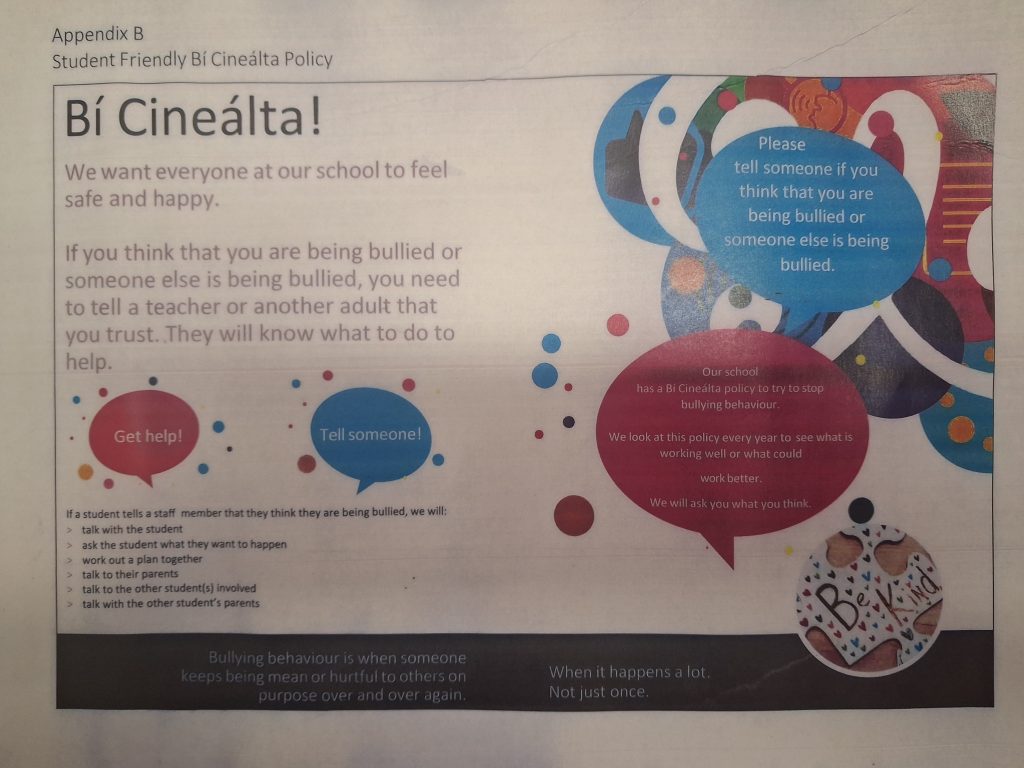
This policy is available to our school community on the school’s website and in hard copy on request. A student friendly version of this policy is displayed in the school and is also available on our website and in hard copy on request.
This policy and its implementation will be reviewed, following input from our school community, each calendar year or as soon as practicable after there has been a material change in any matter to which this policy refers.
Signed: ____________________________________ Date: ________________________ (Chairperson of Board of Management)
Signed: ____________________________________ Date: ________________________ (Principal)
Appendix A
School Bí Cineálta Policy to Prevent and Address Bullying Behaviour
Bí Cineálta Policy to Prevent and Address Bullying Behaviour
The Board of Management of St Patrick’s N.S., Drumkeen has adopted the following policy to prevent and address bullying behaviour.
This policy fully complies with the requirements of Bí Cineálta: Procedures to Prevent and Address Bullying Behaviour for Primary and Post-Primary Schools 2024.
The board of management acknowledges that bullying behaviour interferes with the rights of the child as set out in the United Nations Convention on the Rights of the Child. We all, as a school community, have a responsibility to work together to prevent and address bullying behaviour and to deal with the negative impact of bullying behaviour.
We are committed to ensuring that all students who attend our school are kept safe from harm and that the wellbeing of our students is at the forefront of everything that we do. We recognise the negative impact that bullying behaviour can have on the lives of our students and we are fully committed to preventing and addressing bullying behaviour.
We confirm that we will, in accordance with our obligations under equality legislation, take all such steps that are reasonably practicable to prevent the harassment of students or staff on any of the nine grounds specified: gender, civil status, family status, sexual orientation, religion, age, disability, race and membership of the Traveller community.
We confirm that we will take all such steps that are reasonably practicable to prevent the bullying or harassment of our students in whatever form and however motivated.
Catholic schools have a distinctive understanding of the human person, recognising that every person is created in God’s image and likeness and has inherent dignity as a child of God. This is the basis for ensuring that each person in our school is treated with respect and care, in accordance with the Catholic Schedule.
As a Catholic school, we are committed to respecting the dignity of every individual. No human person is to be devalued, and all have an indispensable part to play in the school community, regardless of difference.
Appendix B
Guide to Providing Bullying Behaviour Update
Guide to providing Bullying Behaviour Update for Board of Management
meeting of ___________________________________
Having reviewed the details of the incidents of bullying behaviour that have been reported
since the previous board of management meeting, the principal must provide the following
information at each ordinary meeting of the board of management:
| Total number of new incidents of bullying behaviour reported since the last board of management meeting. | |
| Total number of incidents of bullying behaviour currently ongoing. | |
| Total number of incidents of bullying behaviour reported since the beginning of this school year. |
Where incidents of bullying behaviour have been reported since the last meeting, the
update must include a verbal report which should include the following information where
relevant:
> the trends and patterns identified such as the form of bullying behaviour, type of
bullying behaviour if known, location of bullying behaviour, when it occurred etc.
> the strategies used to address the bullying behaviour
> any wider strategies to prevent and address bullying behaviour
> if any serious incidents of bullying behaviour have occurred which have had a serious
adverse impact on a student
> if a parent has informed the school that a student has left the school because of
reported bullying behaviour
> if any additional support is needed from the Board of Management
> if the school’s Bí Cineálta policy requires urgent review in advance of the annual review
This update should not include any personal information or information that could identify
the students involved.
Appendix C
Review of the Bí Cineálta Policy
The Board of Management (the Board) must undertake an annual (calendar) review of the school’s Bí Cineálta policy and its implementation in consultation with the school community. As part of the review, this document must be completed.
Bí Cineálta Policy Review
- When did the Board formally adopt its Bí Cineálta policy to prevent and address bullying behaviour in accordance with the Bí Cineálta Procedures for Primary and Post-Primary Schools? Insert date when the Bí Cineálta policy was last adopted by the school.
/ /20
- Where in the school is the student friendly Bí Cineálta policy displayed?
- What date did the Board publish the Bí Cineálta policy and the studentfriendly policy on the school website? / /20
- How has the student friendly policy been communicated to students?
- How has the Bí Cineálta policy and student friendly policy been
communicated to parents
| Yes No |
Have all school staff been made aware of the, school’s Bí Cineálta
policy and the Bí Cineálta Procedures to Prevent and Address Bullying
Behaviour for Primary and Post- Primary Schools?
| Yes No |
Does the Bí Cineálta policy document the strategies that the school uses to prevent bullying behaviour?
| Yes No |
Has the Board received and minuted the Bullying Behaviour?
Update presented by the principal at every ordinary board meeting
over the last calendar year?
| Yes No |
Has the Board discussed how the school is addressing all reports
of bullying behaviour?
| Yes No |
Is the Board satisfied that all incidents of bullying behaviour are
addressed in accordance with the school’s Bí Cineálta Policy?
| Yes No |
Have the prevention strategies in the Bí Cineálta policy been
implemented?
| Yes No |
Has the Board discussed the effectiveness of the strategies used
to prevent bullying behaviour?
- How have (a) parents, (b) students and (c) school staff been consulted with as part of the review of the Bí Cineálta Policy?
- Outline any aspects of the school’s Bí Cineálta policy and/or its
implementation that have been identified as requiring further
improvement as part of this review:
- Where areas for improvement have been identified, outline how
these will be addressed and whether an action plan with
timeframes have been developed?
- Does the student friendly policy need to be updated as a result of
this review and if so why?
| Yes No |
- Does the school refer parents to the complaints procedures if, they
have a complaint about how the school has addressed bullying
behaviour?
| Yes No |
- Has a parent informed the school that a student has left the
school due to reported bullying behaviour?
| Yes No |
- Has the Office of the Ombudsman for Children initiated or
completed an investigation into how the school has addressed an
incident of bullying behaviour?
Appendix D
Notification regarding the board of
management’s annual review of the school’s
Bí Cineálta Policy
The Board of Management of St. Patrick’s N.S. confirms that the Board of Management’s annual review of the school’s Bí Cineálta Policy to Prevent and Address Bullying Behaviour and its implementation was completed at the Board of Management meeting of _____________________________.
This review was conducted in accordance with the requirements of the Department of
Education’s Bí Cineálta Procedures to Prevent and Address Bullying Behaviour for Primary and
Post-Primary Schools.
Signed: ___________________________________________
(Chairperson of Board of Management)
Date: ______________________________
Date of next review: ____________________________________
Signed: __________________________________
(Principal)
Date: ____________________________________
Appendix E
Recording of Bullying Behaviour
- Names of Children Involved
Student(s) Experiencing Bullying _______________________________________
Student(s) Engaging in Bullying Behaviour__________________________________________________________
Other Witnesses (if any) ______________________________________________
- Form of Bullying
(Refer to Section 2.5 – Tick all that apply)
-( ) Physical (e.g., hitting, kicking, pushing)
-( ) Verbal )e.g., name-calling, teasing, insults)
-( ) Psychological (e.g., intimidation, manipulation)
-( ) Cyberbullying (e.g., harmful messages, social media misuse)
-( ) Other: ___________________________________________
- Type of Bullying
(Refer to Section 2.7 – Tick all that apply)
-( ) Peer-to-Peer
-( ) Teacher-to-Student
-( ) Student-to-Teacher
-( ) Group Bullying
-( ) Prejudicial Bullying (e.g., based on race, religion, gender)
-( ) Other: __________________________________________
- Where and When
(If Known)
-Location: _____________________________________
-Date and Time: ________________________________
- Date of Initial Engagement
-with Student(s): ____________________________________
-with Parents: ______________________________________
- Views of Student(s)/Parent(s)
(Regarding the actions to be taken to address bullying behaviour)
________________________________________________________________________________________________________________________________________________________________________________________________________________________________________________________________________
- Date of Review
(To determine if bullying behavior has ceased)
Review Date: ____________________________________
Outcome: _______________________________________
Views of Student(s): ______________________________________________
Views of Parent(s): _______________________________________________
- Engagement with External Services/Supports
(If any)
Services Contacted: ______________________________________________
Details of Engagement: ___________________________________________
- Recording Teacher
Name: _________________________________________________
Date Recorded: _________________________________